top of page

Unit 3 (1st half): c. 200 - 1750 CE
Early Europe and Colonial America
Images 48-72; 84
Main Ideas:
-
As different cultural and intellectual movements sprung throughout Europe, artists sought to depict God in their artworks in different ways
-
As different entities (such as the Catholic Church, French monarchy, Spanish monarchy in America, etc.) sought to expand their power, they commissioned artworks that glorified their power


Early European Art
eea
-
Late Antique Europe: Often adapts pagan elements to Christianity (such as Roman basilica & columns, shepherds, etc.) to encourage Romans to convert to Christianity
-
Early Byzantine Europe: Uses art to emphasize the Orthodox Christian idea of finding God through internal spirituality and not through doctrine
-
Early Medieval Europe: Its artworks contain different motifs all strung together, representative of the different cultures in Western Europe after the fall of Rome (476 CE)
-
Umayyad: Its artwork contains grand mesmerizing imagery to encourage Spaniards to convert to Islam while proclaiming dominance over the Abbasids
Image 48: Catacomb of Priscilla


Name
Catacomb of Priscilla
Location
Rome, Italy
Culture
Late Antique Europe
Date
c. 200 - 400 CE
Material
Excavated tufa and fresco
-
Had lots of Biblical scenes → Sought to allow for the practice of Christianity in its early days when the Roman Empire persecuted Christians (until 313 CE)
-
A Wealthy Roman woman named Priscilla donated the land beneath her estate (which became this catacomb) for the burial of Christians
-
Christianity was just developing in this time, and Christians were persecuted in Rome until 313 CE
-
-
There are many works of art that show the miracles of Christ and the martyrs of Christianity → Sought to encourage others to convert to Christianity by showing how brave and powerful Christians are
-
One room is the Greek Chapel, which is decorated with Old and New Testament Scenes as well as Jesus' miracles
-
The Cubiculum of the Veiled Woman shows a woman in a position of prayer as her soul rises upward to heaven
-
Symbolizes the Christian promise of salvation
-
-
Christ as the Good Shepherd shows Christ surrounded by 3 goats
-
It symbolizes that Christ will care for his followers, just like a shepherd cares for his flock of goats
-
Depicts Christ as a teacher rather than the holy son of God
-
-
-
The works of art were simple as they sought to adopt pagan elements and adapt them to Christianity
-
Christ as the Good Shepherd adopts a Greek idea involving portraying Christ as a shepherd
-
-
Image 49: Santa Sabina


Name
Santa Sabina
Location
Rome
Culture
Late Antique Europe
Date
c. 422 - 432 CE
Material
Brick and stone, wooden roof
-
Was an Early Christian Church in a former Roman basilica with a longitudinal (rectilinear) focus
-
Roman basilicas were grand and were used for governmental purposes → Christians reused those same buildings as they represented authority & power
-
The interior architecture of the Church helps guide our focus to the front (the altar)
-
The nave arcade has weight-bearing columns (reused from pagan times), and they have arches between them, and looking across the columns guides our focus to the altar in the front of the church
-
The inlaid stone patterns above the columns are decorated with chalices and bread plates: References to the eucharist
-
-
The rectilinear focus allows for large numbers of people to enter the church to focus their worship on the altar
-
In contrast, Greek & Roman temples were much smaller and only had space to hold a cult statue
-
-
-
The wooden doorway is carved with Old & New Testament Scenes
-
There are some scenes of Jesus's crucifixion, which is unique since most early Christian art focuses on Jesus's miracles in order to gauge more support for Christianity
-
-
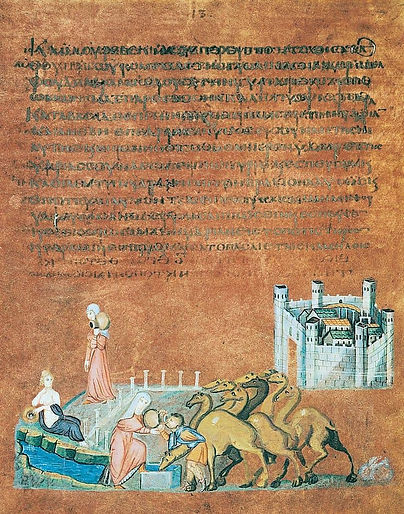
Image 50: Rebecca and Eliezer at the Well and Jacob Wrestling the Angel, from the Vienna Genesis

Name
Rebecca and Eliezer at the Well and Jacob Wrestling the Angel, from the Vienna Genesis
Culture
Early Byzantine Europe
Date
Early sixth century CE
Material
Illuminated manuscript (tempera, gold, and silver on purple vellum)
-
Rebecca & Eliezer at the Well: Uses elements of classical art in an illustration of a scene from the Old Testament Book of Genesis
-
The Story: Abraham sent his servant Eliezer to look for a wife for Abraham's son Isaac → Eliezer took 10 camels with him and stopped at a well to give them water → Eliezer prayed that Isaac's future wife would assist him in watering the camels → Rebecca arrives as she thinks she is the wife for Isaac
-
Elements of Classical Art:
-
The colonnade (row of columns) on the bridge
-
Leftmost figure is a reclining nude woman, representing sensuality and emotion
-
The castle at the top right ignores spatial consistency (because it's relatively small and has columns in inconsistent places)
-
-
-
Jacob Wrestling the Angel: Also uses elements of classical art in an illustration of a scene from the Old Testament Book of Genesis
-
The Story: Jacob (depicted in red and brown tunic in top center) wakes up and leads his wives and servants (who are on donkeys) across a bridge → Jacob (depicted in brown tunic in bottom center) then wrestles an angel to get a blessing → The Angel blesses him, so Jacob is renamed Israel, and he then walks off
-
Elements of Classical Art:
-
The bridge has Roman-style arches and a colonnade
-
The perspective of the bridge is skewed: The columns above the bridge on the far side appear taller than those on the near side
-
-
Image 51: San Vitale


.jpeg)


Name
San Vitale
Location
Ravenna, Italy
Culture
Early Byzantine Europe
Date
c. 526 - 547 CE
Material
Brick, marble, and stone veneer; mosaic
-
Centrally planned church → Emphasizes the orthodox Christian belief of finding God through internal spirituality and not through doctrine
-
Unlike Santa Sabina which is rectilinear (and has a focus on learning doctrine from the priest at the altar), this has one central octagonal space
-
The central space has a raised ceiling (clerestory) so that sunlight can come in, allowing people who stand there to feel a spiritual connection to God above them
-
-
Ravenna was controlled by the Goths who didn't believe in orthodox Christianity (they instead believed Christ was subordinate to God and the Holy Trinity) → Emperor Justinian & Empress Theodora of the Byzantine Empire attempt to assert their own authority in Ravenna to promote the revival of Orthodox Christianity
-
Justinian's Mosaic:
-
Justinian's purple robe and halo symbolize religious power
-
He is surrounded by religious, political, and military leaders → Shows that he has religious, political, and military power
-
The person 3rd from right has an inscription above him saying that he's Bishop Maximus (Bishop of Ravenna) → Shows that he's subordinate to Justinian (as Justinian's in the center)
-
-
Theodora's Mosaic:
-
Complementary to Justinian's Mosaic (purple robe halo, golden background, etc.
-
Surrounded by attendants of her Byzantine imperial court → Shows that the Byzantine imperial court's authority extends to Ravenna
-
-
-
Image 52: Hagia Sophia


Name
Hagia Sophia
Location
Constantinople (Istanbul)
Artist
Anthemius of Tralles and Isidorus of Miletus
Date
c. 532 - 537 CE
Material
Brick and ceramic elements with stone and mosaic veneer
-
Has a large dome, and it has complex & kaleidoscopic decorations on the walls, floors, and ceilings → Creates a feeling of heaven and spirituality
-
The large dome above the main hall represents a feeling of heaven when one stands underneath (similar to San Vitale)
-
The dome has small windows along its bottom, so when sunlight comes in, it appears that the dome is floating → Gives a feeling of heaven
-
The dome is circular while its base is square → Pendentives (curved triangles) and piers (hidden beams) bear its weight
-
-
The floors and walls of the building have complex kaleidoscopic decorations → When people look at them, they are "lost in thought," resembling the same spiritual feeling people acquire in heaven
-
The paint and tiles are in random patterns, so they reflect and accentuate the sunlight in random ways
-
-
The idea of finding God through spirituality and not though doctrine represents the ideals of Orthodox Christianity (like in San Vitale)
-
Once had many decorations but were mostly destroyed during the iconoclasm controversy (700s-800s CE)
-
The apse (behind the dome) has a mosaic of Virgin Mary and Jesus
-
-
Meant to reinforce the power of the ruler
-
Located right next to Byzantine emperor's palace
-
Ottoman sultan has his own lodge (elevated from the public) from where he worships
-
-
First an Orthodox Christian Church (under Byzantine Empire) then a Mosque (when Ottomans conquered Byzantines) in 1453
-
Thus, it represents a combination of cultures: Roman-style basilica, Christian imagery, Islamic calligraphy, Byzantine architecture
-
-
Image 54: Virgin (Theotokos) and Child between Saints Theodore and George

Name
Virgin (Theotokos) and Child between Saints Theodore and George
Culture
Early Byzantine Europe
Date
Sixth or Early 7th Century CE
Material
Encaustic on wood
-
Represents a sense of spirituality by showing a direct pathway from the people to God
-
The spatial ambiguity and imagery convey spiritualism
-
The heads look very flat, and the space is compressed → Shows that the figures in the image are living in the spiritual realm, not the realm world
-
The figures have golden halos → Shows their spiritual status
-
-
As we look at the painting, we are directly connected to God through a pathway involving the figures present:
-
The first thing we see are the saints at the bottom left and bottom right of the image; They are looking directly at us to wait for our acknowledgement
-
Then, the saints pass on our acknowledgement to Virgin Mary (in the center)
-
Then, Virgin Mary passes on our acknowledgement to the 2 angels above her
-
Then, the 2 angels are looking upward toward God and heaven, so they pass on our acknowledgement to God
-
Here is a detailed photo of the pathway (with arrows):
-
-

Early Medieval Europe
Image 53: Merovingian Looped Fibulae

Name
Merovingian Looped Fibulae
Culture
Early Medieval Europe
Date
Mid Sixth Century CE
Material
Silver gilt worked in filigree, with inlays of garnets and other stones
-
Each non-Roman culture in Western Europe had a fibulae (as a brooch for their military), but they added their own cultural twists to it; this culture added an eagle motif
-
Fibulae are brooches used by the militaries of Medieval European cultures, and they became popular when the Roman military used it
-
They are often found in gravesites of fallen soldiers
-
They are roughly in the shape of a crossbow → Conveys their military importance
-
-
Manufactured with a technique called cloisonné: You first make a frame of metal wires (to outline the fibulae's jewelry), then you insert semiprecious stones in the frame
-
This culture (the Merovingian Dynasty) added an eagle motif to their fibulae
-
Each fibulae pictured has 7 eagles (those small beaded circles with a hole next to them are all mini eagles with a small beak)
-
The eagle motif was initially a pagan symbol, but it was adapted to represent St. John → Shows how Early Christian cultures adapted pagan elements to Christianity (like Catacomb of Priscilla)
-
-
Image 55: Lindisfarne Gospels:
St. Matthew cross-carpet page;
St. Luke portrait page;
St. Luke incipit page


Name
Lindisfarne Gospels:
St. Matthew cross-carpet page;
St. Luke portrait page;
St. Luke incipit page
Culture
Early Medieval (Hiberno-Saxon) Europe
Date
c. 700 CE
Material
Illuminated manuscript (ink, pigments, and gold on vellum)
-
St. Matthew Cross-Carpet Page: Has complex intertwined decorations → As devout monks look at that, they get lost thought, giving a feeling of spirituality/meditation
-
As people traveled throughout Europe, they mixed different ideas and cultural motifs to create that complex carpet design
-
Small animals and bird heads give the carpet a sense of movement → Further represents monks getting lost in thought and mesmerized upon looking at this (conveying spirituality)
-
Similar to kaleidoscopic decorations of Hagia Sophia (Image 52)
-
-
St. Luke Portrait Page: Represents a scholar pose
-
Represents a man lost in thought, inscribing something on a scroll
-
The purple robe is common among high-ranking educational and religious leaders
-
The flatness of the image as well as his halo signify his divine status
-
The blue-winged calf above him has a halo and holds a book → Represents the gospel (news from god)
-
Similar to Justinian's & Theodora's Mosaics in San Vitale (Image 51)
-
-
St. Luke Incipit Page: Has some swirling interlaced designs and texts to signal a commencement of prayer
-
Not as decorated as the Cross-Carpet page because this page is more to signal to the monk to start prayer, while the Cross-Carpet page is more to allow the monk to actually pray for a long time
-
The text signifies a start to prayer: "As many have taken it in hand to set forth in order
-
Image 56: Great Mosque


Name
Great Mosque
Location
Córdoba, Spain
Culture
Umayyad
Date
Begun Construction: c. 785 - 786 CE
Material
Stone masonry
-
Its large hypostyle hall & elaborate mihrab have repetitive motifs that make them look like a spiritual illusion
-
The large hypostyle hall has stacked columns each with an arch with repeated red and white stripes → When you look at it, the hall looks much larger and seems infinite → Represents a spiritual illusion
-
The columns are reused from Roman times
-
The light from the clerestory (raised ceiling) illuminates the columns, enhancing the spiritual illusion
-
-
The Mihrab is decorated with gold tesserae → Looking at it creates a mesmerizing illusion, representing spirituality
-
Similar to Hagia Sophia's kaleidoscopic walls, floors, and ceilings (Image 52)
-
There are many horseshoe arches, representative of Visigothic Tradition
-
-
The building was initially a Visigothic church, then became a mosque
-
Umayyads were removed from Damascus by the Abbasids in mid-7th century → Moved to Córdoba, Spain, to reestablish their capital
-
The minaret (from where the priest calls to prayer) is in a Christian bell tower
-
The courtyard is full of orange trees and was used for ritual ablution (washing oneself before prayer)
-
-
Image 57: Pyxis of al-Mughira

Name
Pyxis of al-Mughira
Culture
Umayyad
Date
c. 968 CE
Material
Ivory
-
The imagery depicts the Umayyad Caliphate's imperial power over the Abbasids
-
Has 4 medallions (1 on each side; one such side is pictured above with the medallion in the center)
-
Medallion 1 (pictured above):
-
Lute player in middle; man with scepter (representing Umayyads) on left; man with a fan (representing Abbasids) on right
-
Shows that Umayyads are superior to Abbasids because a scepter gives someone the right to rule
-
-
Medallion 2:
-
2 men collecting eggs from falcons' nests → Represents Umayyads' legitimacy
-
-
Medallion 3:
-
Lions attacking 2 bulls → Symbolizes that the Umayyads (shown as lions) are victorious over the Abbasids (shown as bulls)
-
-
Medallion 4:
-
Shows men on horseback collecting dates → Alludes to the lands that the Umayyads lost to the Abbasids in the Middle East → Signifies that the Umayyads seek to regain control over them
-
-
A coming-of-age gift to Al-Mughira's son
-
Placed in the center of the palace's main room → Shows its importance
-
-
Arabic inscription at the top says that God will have mercy upon Al-Mughira's son → Shows that God favors the Umayyads (ruled by Al-Mughira) over the Abbasids
-
This elaborate ivory carving represents the flourishing luxury arts workshops in Córdoba → Hints at the Umayyad's economic success
-
Medieval European Art
mea
-
Romanesque: Has mostly Roman-style structures (such as simple rounded arches) and other simple structures & illustrations without much elegance or intricacy
-
Gothic: Elaborates on Romanesque art with more intricate designs (such as pointed arches & stained-glass windows). Has images of religious figures framed within shiny medallions (in manuscripts & in stained-glass windows)
-
Proto-Renaissance: An early part of the Renaissance that depicts religious figures in a somewhat realistic & naturalistic way
-
Late Medieval Spain: Artworks from this period represent cross-cultural exchanges between Christians, Jews, and Muslims in Medieval Spain
-
Ottoman: Sought to showcase the supremacy of the Ottoman Empire & of its features (such as Orthodox Islam) to expand its power in nearby regions
Image 58: Church of Sainte-Foy


Name
Church of Sainte-Foy
Location
Conques, France
Culture
Romanesque Europe
Date
Church: c. 1050 - 1130 CE
Reliquary of Saint Foy: 9th century CE with later additions
Material
Church: Stone
Tympanum: Stone and paint
Reliquary: Gold, silver, gemstones, and enamel over wood
-
Church architecture (interior & exterior) has lots of round arches, representative of Romanesque style
-
The exterior has round arches in its windows and doorway
-
The interior also has round arches along the nave (between columns) with a barrel-vaulted ceiling
-
Barrel-vault: The ceiling is like one long arch with columns on either side
-
Because the arches distribute a lot of weight on its sides, the walls and columns are very thick
-
-
Built for pilgrimage purposes
-
Lots of people made pilgrimages to Santiago de Compostela in Spain, and they stopped here on their way
-
Pilgrims enter through the side door then crowd around the apse (in the front) then visit the many radiating chapels around the apse before exiting the other side
-
In one of the radiating chapels is the reliquary of Saint-Foy
-
-
-
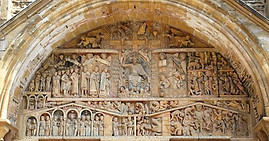
Tympanum (semicircular panel above doorway) depicts the last judgement scene
-
In this scene, Jesus determines who'll go to heaven or hell
-
Jesus is in the center in a mandorla (full-body halo)
-
His right hand points upward because people on that side go to heaven
-
There are many important religious figures (Mary, Peter, etc.)
-
Below them is the house of paradise for people in heaven
-
-
His left hand points downward because people on that side go to hell
-
There is lots of chaos and disorder, a devil with a hanged man (bottom side), and fires of hell
-
-
Below Jesus are angels who'll weigh the souls of the dead to see if they'll go to heaven or hell
-
-
-
Reliquary of Saint Foy contains the relics of St. Foy → Represents the rise of relic worship in Europe
-
Christian honored the relics (body parts and clothes) of saints → Made pilgrimages to special churches that held such relics
-
Saint Foy was a young girl in Roman-occupied France who was killed for worshipping Christianity instead of pagan gods → She was honored as a martyr in this reliquary
-
Her reliquary is elaborately decorated
-
Her head is actually from a Roman statue of a child → Makes this statue more important by associating it with the riches of the Roman empire
-
This practice (of reusing older artifacts) is spolia
-
-
-
Image 59: Bayeux Tapestry
%20(1).jpg)
%20(1)%20(1).jpg)
Name
Bayeux Tapestry
Culture
Romanesque Europe (English or Norman)
Date
c. 1066 - 1080 CE
Material
Embroidery on linen
-
A continuous narrative depicting the Norman (French) Conquest of England in 1066
-
The Normans of France (led by King William) led a conquest of England (led by King Harold), and the Normans won
-
The tapestry is very long and depicts a long continuous story showing multiple scenes in this conquest:
-
First, it depicts the death of Edward the Confessor (previous English king) and the crowning of the new English King, Harold
-
Then, the Normans start to cut down trees to make ships for battle
-
Then, the Normans cross the English Channel and arrive in England
-
Then, King William (Norman King) feasts with his soldiers
-
This is the 1st photo pictured above
-
-
Then, the Normans build a defensive castle
-
Then, the battle begins where the Norman cavalry charges at English King Harold and his forces
-
This is the 2nd photo pictured above
-
The Norman forces on horseback (left) are charging at the English forces (right) → Many dead people are lying on the ground
-
-
In the end, English King Harold is slaughtered
-
-
Characteristics of Romanesque Art:
-
Represents a continuous narrative like Trajan's column (Image 45)
-
Very stylized and flat, making it look a bit imaginary/divine and not really realistic, but not too elaborate or decorated
-
Some designs (like the banquet table in the 1st photo above) are shaped like an arch
-
-
Image 60: Chartres Cathedral
.jpeg)

.jpeg)
.jpeg)


Name
Chartres Cathedral
Location
Chartres, France
Culture
Gothic Europe
Date
Original Construction: c.1145 - 1155 CE
Reconstructed: c.1194 - 1120 CE
Material
Limestone, stained glass
-
Architecture (inside & outside): Has many pointed and intricate designs → Represents the ideals of Gothic art
-
Gothic art is similar to Romanesque art but involves pointed arches and intricate designs rather than elegant simple designs
-
The front facade has many pointed arches, and the 2 towers in the front are very pointed
-
The interior nave also has rib vaults at the top with thinner walls
-
Rib vault is a type of ceiling that is two pointed arches intersected together
-
The walls are much thinner than Romanesque nave walls because a rib vault distributes less weight than a barrel vault
-
-
Had large stained-glass windows in the walls → There are many flying buttresses (support towers) outside that help offset some of the weight of the walls to allow for such windows
-
-
Front facade's tympana: Represent various moments of Jesus's life
-
Tympanum of left portal: Christ before taking on physical form
-
4 angels are below him and are trying to look up at him
-
Prophets are in the lintel, and they begin to see the future of Jesus's plan for mankind
-
-
Tympanum of right portal: Various scenes from Virgin Mary's life until the time when Christ is born
-
The bottom lintel depicts her bearing of Christ
-
On the left is the Annunciation: Archangel Gabriel announces to Virgin Mary that she'll bear the son of God
-
Next is the Visitation: Mary (pregnant with Jesus) is visited by her cousin Elizabeth (pregnant with St. John the Baptist)
-
In the center is Mary who has just given birth to Jesus
-
To the right is the Adoration (people come to honor Jesus)
-
-
Top lintel: Presentation of Jesus Christ (as a child) in the temple
-
Actual Tympanum: Virgin Mary enthroned with Jesus Christ as a child on her lap; angels on either side
-
Jesus is on the "Throne of Wisdom"
-
-
-
Tympanum of center portal: 2nd Coming of Christ (the end of time)
-
Jesus sits in the middle (much larger than the others, seated on the throne of heaven surrounded by a mandorla) and is surrounded by the 4 evangelists (Matthew, Mark, John, Luke)
-
-
Jamb Figures (in the doorway): Old Testament Prophets, Kings, and Queens who "welcome" us into the church
-
-
The stained glass windows show symbols important to Jesus's life → The sun shines through them and illuminates them so that people can feel like they're in heaven inside the church
-
The Blue Virgin Window:
-
Shows Virgin Mary enthroned in a blue robe and blue halo with Jesus on her lap, surrounded by 6 angels
-
-
The North Rose Window:
-
Center depicts Virgin Mary holding Jesus as a child
-
Outer circles depict 4 doves, 8 angels, 12 kings of Judah (Christ's ancestors), and 12 minor prophets
-
Small clover-like shapes next to the outer ring depict the French coat of arms (fleurs-de-lis) because this window was donated by the mother of King Louis IX (Queen Blanche of Castille)
-
-
5 lancets below the rose: Saint Anne in the center lancet; other kings mentioned in Old Testament in the other lancets
-
-
Image 61: Dedication Page with Blanche of Castile and King Louis IX of France; Scenes from the Apocalypse from Bibles Moralisées


Name
Dedication Page with Blanche of Castile and King Louis IX of France; Scenes from the Apocalypse from Bibles Moralisées
Culture
Gothic Europe
Date
c. 1225 - 1245 CE
Material
Illuminated manuscript (ink, tempera, and gold leaf on vellum)
-
1st page: Depicts Queen Blanche of Castile and King Louis IX of France in a monarchical fashion
-
Blanche and Louis IX are surrounded by a gold background (like a halo) → Signifies that they are in their own heavenly sphere and rule over the entire French community (represented by the buildings in the background)
-
These 2 are the owners of the manuscript
-
-
-
2nd page: Depicts Bible scenes, but it alters certain elements of the scenes based on European societal values at the time it was made (the 13th century)
-
The book contains many pages like this one, each has 8 roundels that each depict a Bible scene
-
In the original Bible, Jesus was the main figure in most pictures, but here, the kings are shown as ornamented and grand as Jesus
-
This is because of the rise of monarchies in 13th-century Europe
-
-
The original Bible regarded Jews as somewhat equals (or even indistinguishable) to Christians, but this manuscript depicts Jews in a bad light
-
This is because Jews were persecuted by Christians in medieval Europe
-
-
The book is called Bibles Moralisées (Moralized Bible) because it has "moralized" the Bible based on contemporary (at the time, which was 13th century) societal values
-
Image 62: Röttgen Pietà

Name
Röttgen Pietà
Culture
Late Medieval
Date
c. 1300 - 1325 CE
Material
Painted wood
-
Represents mysticism: The idea that people can connect with God on an emotional level
-
Depicts the Lamentation: When Virgin Mary laments the death of her son Jesus Christ
-
There is less distance between God and humans: Instead of showing God as superior and heavenly, it depicts Virgin Mary as a human → We can empathize with her
-
Uses vivid imagery to show sadness
-
Bright brown and red colors
-
Elaborate drapery
-
-
Image 63: Arena (Scrovegni) Chapel, including Lamentation

.jpeg)

Name
Arena (Scrovegni) Chapel, including Lamentation
Location
Padua, Italy
Culture
Unknown architect
Artist is Giotto di Bondone
Date
Chapel: c. 1303 CE
Fresco: c. 1305 CE
Material
Brick (architecture) and Fresco
-
Church Architecture: Seems smaller, private, and less grand than other churches
-
Seems like a house: Much more "realistic" and natural → Represents Proto-Renaissance idea of a hybrid between realism & divinity
-
-
Interior Frescoes: Depict the religious figures in a hybrid of divinity and naturalism
-
The whole interior is a continuous spiral of 3 registers that tell the story of Christ
-
Top register: Jesus's grandparents & parents
-
Middle register: Life of Jesus
-
Bottom register: Passion of Jesus (his death) and Lamentation
-
-
The scene on the front wall is the Last Judgement
-
Jesus is in the center, deciding who'll go to heaven or hell
-
-
In the lamentation (pictured above), Virgin Mary and other followers are mourning Jesus's death
-
Virgin Mary holds the dead Jesus's body with a sense of disbelief
-
The main divine aspect is the angels flying above the body
-
-
Elements of Proto-Renaissance Art that prove that the paintings are a hybrid of divinity and naturalism:
-
The heads have halos, but the bodies are naturalized like humans
-
Chiaroscuro: Uses light and shadows to make the bodies appear more real
-
The main divine aspect is the spatial ambiguity
-
The background appears plain, and the church is a small enclosed space → Appears like the figures are in heaven
-
-
-
Image 64: Golden Haggadah (The Plagues of Egypt, Scenes of Liberation, and Preparation for Passover)


Name
Golden Haggadah (The Plagues of Egypt, Scenes of Liberation, and Preparation for Passover)
Culture
Late Medieval Spain
Date
c. 1320 CE
Material
Illuminated Manuscript (pigments and gold leaf on vellum)
-
Tells the story of the Jewish holiday of Passover
-
The Story:
-
The Jews were enslaved in Egypt → Moses implemented the "Plagues of Egypt," a series of bad things that would happen to the Egyptians if they don't free the Jews from slavery
-
After Moses's last and deadliest plague (the firstborn child of each Egyptian family would be killed), he told each Jewish family to put a red mark above their house so that the Angel of Death would "pass over" those homes and free them
-
-
Manuscript 1: The Plagues of Egypt
-
All 4 scenes depict different plagues that affected the Egyptians, yet none of them convinced them to release the Jews
-
-
Manuscript 2: Scenes of Liberation (the Jews are liberated from Egypt)
-
Moses implements the last plague (death of the firstborn child) (top right) → Egyptian pharaoh is convinced to free the Jews (top left)
-
Some Egyptians pursue them (bottom right), but the Jews manage to safely cross the Red Sea (bottom left)
-
-
Manuscript 3: Preparation for Passover
-
Depict people dancing, slaughtering animals for food, etc.
-
-
These manuscripts were used to recite the story of Passover at a special Passover dinner called seder
-
Golden Haggadah was really expensive (due to golden color) → Must be commissioned by a wealthy family
-
-
Has some Gothic elements: Long clothes, pointed architecture, ornamented decoration of Egyptian pharaoh
-
-
Has some Islamic influence → Represents cross-cultural exchange between Christians, Jews, and Muslims in Medieval Spain
-
An example is the Islamic motif on Miriam's (Moses's wife) timbrel in the top right of the 3rd manuscript
-
This book generally represents the thriving of Jewish culture in Medieval Spain while adapting it to the style of Medieval European manuscripts, like Bibles Moralisées (Image 61)
-
Image 65: Alhambra


.jpeg)
Name
Alhambra
Location
Granada, Spain
Culture
Nasrid Dynasty
Date
c. 1354 - 1391 CE
Material
Whitewashed adobe, stucco, wood, tile, paint, and gilding
-
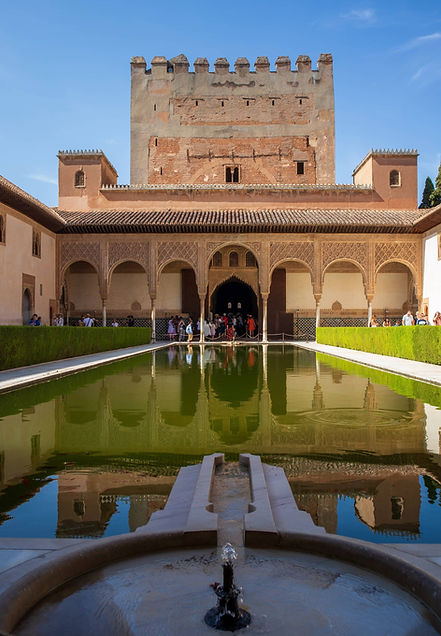
Comares Palace: Uses complexity of light, geometric patterns, and spaciousness to create a mesmerizing illusion → Spirituality
-
Similar to Hagia Sophia (Image 52) where the walls have kaleidoscopic decorations, and when light shines on them, it creates a mesmerizing mosaic that makes us feel "lost in thought" (hence, spiritual) when we look at them
-
Also has a high ceiling (like the dome of Hagia Sophia or San Vitale) → When one stands below it, they feel a spiritual connection to God
-
-
Palace of the Lions: Complex hydraulic system of fountains + intricate muqarnas that hold up the vaulted ceiling → Looking at these intricate decorations creates a mesmerizing illusion that gives a sense of spirituality
-
This also has kaleidoscopic decorations like the Comares Palace that help give a spiritual feel
-
The water from the fountains helps give beauty to the architecture, and when sunlight shines on water, it also reflects in a mesmerizing kaleidoscopic way to give a sense of spirituality
-
Although the interior space is small, the shading & arches make it feel grander than it is, allowing one to feel a spiritual illusion once inside
-
-
Represents a confluence of Christian, Jewish, and Islamic influences because this does not have domes or minarets or mihrabs like Mosques in the Middle East; rather, it is adapted to the style of Medieval European castles and palaces based on a rectangular structure
Image 84: Mosque of Selim II


Name
Mosque of Selim II
Location
Edirne, Turkey
Culture
Sinan (architect)
Date
1568 - 1575 CE
Material
Brick and stone
-
Ottomans commissioned this near the border of the Ottoman Empire & Balkan Peninsula to showcase the supremacy of Orthodox Islam over other religions in Eastern Europe
-
Ottoman Empire had its base in Istanbul, but it wanted to conquer Eastern Europe
-
Lost against Vienna in 1529 but conquered Hungary in 1541
-
Ottomans had some loose control over the Balkans (just west of Turkey), but the Balkan peninsula had its own religious practices
-
Had unorthodox Islamic practices and even some Christian practices
-
-
Thus, Ottoman Sultan Selim II commissioned this mosque near the frontier of Istanbul and Eastern Europe to showcase that the beliefs of Orthodox Islam (that this mosque was representing) were superior to the religious practices of Eastern Europe
-
This sought to strengthen Ottoman control over the region by encouraging the people to follow the Ottoman's region, which is Orthodox Islam
-
-
-
The interior has a large weightless dome (like Hagia Sophia, Image 52) → Represents the overarching spiritual influence of Orthodox Islam
-
When people stand under the dome, they feel a sense of spirituality, but they realize that this sense of spirituality is from Orthodox Islamic divinity
-
-
Quattrocento Art
qa
-
Northern Quattrocento: Had more of a focus on religious scenes with naturalism and lots of intricate symbolic details
-
Southern Quattrocento: Focused more on classical (pagan) mythology, realism, and having balance & symmetry
Image 66: Annunciation Triptych (Merode Altarpiece)

Name
Annunciation Triptych (Merode Altarpiece)
Artist
Workshop of Robert Campin
Date
1427 - 1432 CE
Material
Oil on wood
-
Uses various realist elements & features of Renaissance art (listed below) to highlight the spirituality of Virgin Mary
-
List of Realist Elements & Features of Renaissance Art:
-
Oil Paint → Bright colors
-
Chiaroscuro: Use of light and shadows to make figures look more realistic
-
This makes the pot at the top left of the middle panel look very bright to mimic the spiritual power of Virgin Mary
-
-
Attention to specific detail: Small details can relate to larger religious themes
-
The rust on the door (left panel) mimics the carpenter's wooden carving (right panel) to reference the cross
-
-
-
Central Panel: The Annunciation
-
Archangel Gabriel (left) announces to Virgin Mary (right) that she'd bear Jesus Christ
-
Both of their dresses have intricate folds → Makes them look more realistic & emphasizes their divinity and power
-
-
Left Panel: Commissioners kneel to honor Virgin Mary
-
The 2 men are depicted in naturalistic clothes, but their clothes are less elaborate than Virgin Mary's dress → Emphasizes Virgin Mary's spiritual significance
-
There is a garden behind the gates (which is closed) → The garden references Virgin Mary's beauty
-
-
Right Panel: Joseph (Mary's husband) is a carpenter and is making something out of wood → References the cross (where Jesus died)
-
The mousetrap references his death, and the wood & axe reference the cross
-
-
Image 68: The Arnolfini Portrait

Name
The Arnolfini Portrait
Artist
Jan van Eyck
Date
c. 1434 CE
Material
Oil on wood
-
Uses realist imagery to represent the wealth, loyalty, and spirituality of the couple above
- They are joining hands → Symbol of loyalty
- Dog at the bottom is a symbol of fidelity & loyalty
- Oranges on windowsill symbolize wealth
- The Woman's elaborate dress with intricate folds symbolizes wealth & purity
- Other realist & naturalistic elements symbolize God and the spiritual connection/affirmation of this relationship
- The candle in the chandelier symbolizes God
- The roundels (small circles) around the mirror show scenes of the Passion (Christ's death)
- The bedroom was generally a public place for viewers, and the mirror at the top allows us (the viewers) to see the couple's loyalty & wealth
Image 67: Pazzi Chapel


Name
Pazzi Chapel
Location
Part of Basilica di Santa Croce, Florence, Italy
Artist
Filippo Brunelleschi (architect)
Date
1429 - 1461 CE
Material
Masonry
-
Uses rational geometry and has a central dome → Gives the chapel a sense of Roman classicism to juxtapose with its divine purpose
-
Small rectangular space with a large circular dome in the center → The dome appears to dominate the building (like the Pantheon, Image 46)
-
The dome has a small oculus (hole) that provides light and gives a sense of divinity
-
There are barrel vaults on either side of the dome (since the ceiling is a rectangle, not a square)
-
-
Uses perfect squares, rectangles, circles, and semicircles in its art and architecture → Gives the chapel a sense of rationality and classicism that juxtaposes with its spiritual purpose
-
The outside has a loggia (outdoor portico) with Roman-style arches to accommodate more people
-
The main divine aspect is the small terracotta roundels (designed by Lucca della Robbia) that depict religious figures
-
Image 69: David

Name
David
Artist
Donatello
Date
c. 1440 - 1460 CE
Material
Bronze
-
Uses Roman classical techniques to depict David's virtue in slaying Goliath
-
Similar to Doryphoros (Spear Bearer) (Image 34)
-
David is idealized by standing in contrapposto on an elevated platform → Emphasizes his virtue
-
His body is nude, and the artist showed his muscles to emphasize his youthful vigor and inner strength
-
Represents the story of David & Goliath (Old Testament):
-
Goliath (a giant) threatened an Israeli village, and no one except for David was brave enough to be willing to fight off Goliath
-
David said that he had killed many wild animals who threatened his farm, and since God saved him in those battles, God will help him defeat Goliath → David eventually fought & beheaded Goliath
-
-
Goliath is at David's feet (and is much smaller than David) → Shows that God can give people strength & wisdom to overcome their obstacles (just like how David beheaded Goliath)
-
Placed in courtyard of Medicis in Florence → Shows that the people of Florence believe God is on their side in conquering their rivals such as Naples and Milan (just like how God helped David behead Goliath)
-
Image 70: Palazzo Rucellai
.jpeg)
Name
Palazzo Rucellai
Location
Florence, Italy
Artist
Leon Battista Alberti (architect)
Date
c. 1450 CE
Material
Stone, masonry
-
Uses classical geometry to symbolize humbleness, civic order, harmony, and stability instead of extravagance
-
Bottom tier: Made of cross-hatched stone and engaged columns (pilasters)
-
2nd and 3rd tiers have Roman-style arches and pilasters
-
First floor for family, second for guests, third is for private use, and fourth floor is hidden from outside and used for servants
-
Represents characteristics of the Southern Renaissance as it uses Roman-style arches and geometric shapes to emphasize balance and harmony
-
Doesn’t look extravagant like a palace → Emphasizes humbleness
-
-
Alberti’s book On Painting emphasizes the use of clean geometry in architecture
-
Image 71: Madonna and Child with Two Angels
.jpeg)
Name
Madonna and Child with Two Angels
Artist
Fra Filippo Lippi
Date
c. 1465 CE
Material
Tempera on wood
-
Depicts Madonna (Virgin Mary) and her child (Jesus) in a light, playful, humble way → Emphasizes our personal connection to God
-
Halos are faint → God isn’t that separated from humans
-
Lots of natural and realist elements (shadows, hair, non-elaborate clothing, etc.) → God is just like humans and has a personal connection to us
-
Uses lots of light color tones to emphasize the tenderness of God and Virgin Mary
-
-
There is a frame in the picture, and the figures are coming out of the frame to appear closer to us → Shows that God is coming closer to us
-
The painting's commissioner likely used this scene as a model for his own relationship with his children → Emphasizes his family’s personal connection to God
-
Image 72: Birth of Venus

Name
Birth of Venus
Artist
Sandro Botticelli
Date
c. 1484 - 1486 CE
Material
Tempera on canvas
-
Venus's arrival to the land from a seashell represents a combination of physical beauty and spiritual beauty, using Classical & Gothic elements
-
Classical elements:
-
Revival of pagan gods: Venus arises from a shell in the center; Zephyr (left) is blowing a wind at her to the shore on the right, and a nymph (right) is covering her with a blanket once she reaches the shore
-
Venus appears nude and in contrapposto, representing a realist classical body (like Doryphoros (Spear Bearer), Image 34)
-
Compressed sense of space (skewed perspective)
-
-
Gothic elements:
-
The bodies are elongated, curved, and seem floating in the air, giving them an elaborate decorated feel
-
-
How it represents physical beauty:
-
Venus is depicted in a realist fashion (nude, contrapposto, realistic human body/hair, etc.) → Represents that anyone can achieve that level of physical beauty
-
-
How it represents spiritual beauty:
-
Venus is depicted in a divine fashion because she's floating in the air and is surrounded by other pagan gods → Venus inspires our spiritual beauty (our Godlike qualities such as love, gracefulness, elegance, etc.)
-
Botticelli adapted this to Christianity to inspire people to love God more so that they can achieve these spiritual qualities
-
-
bottom of page